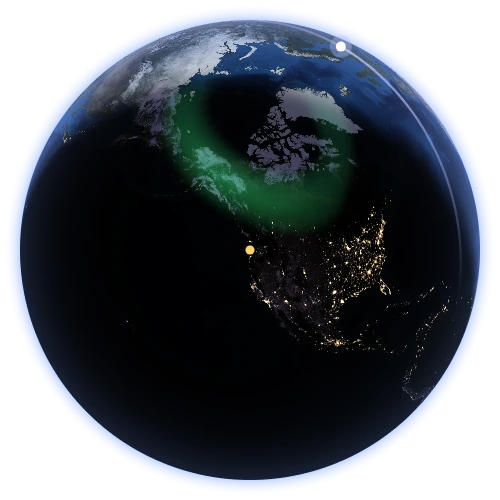
A public web application that brings satellite tracking, visible passes, launches, and space weather together.
Built and maintained by me since March. It began as a simple class project using a timer-triggered function to collect API data and grew into the application shown here.
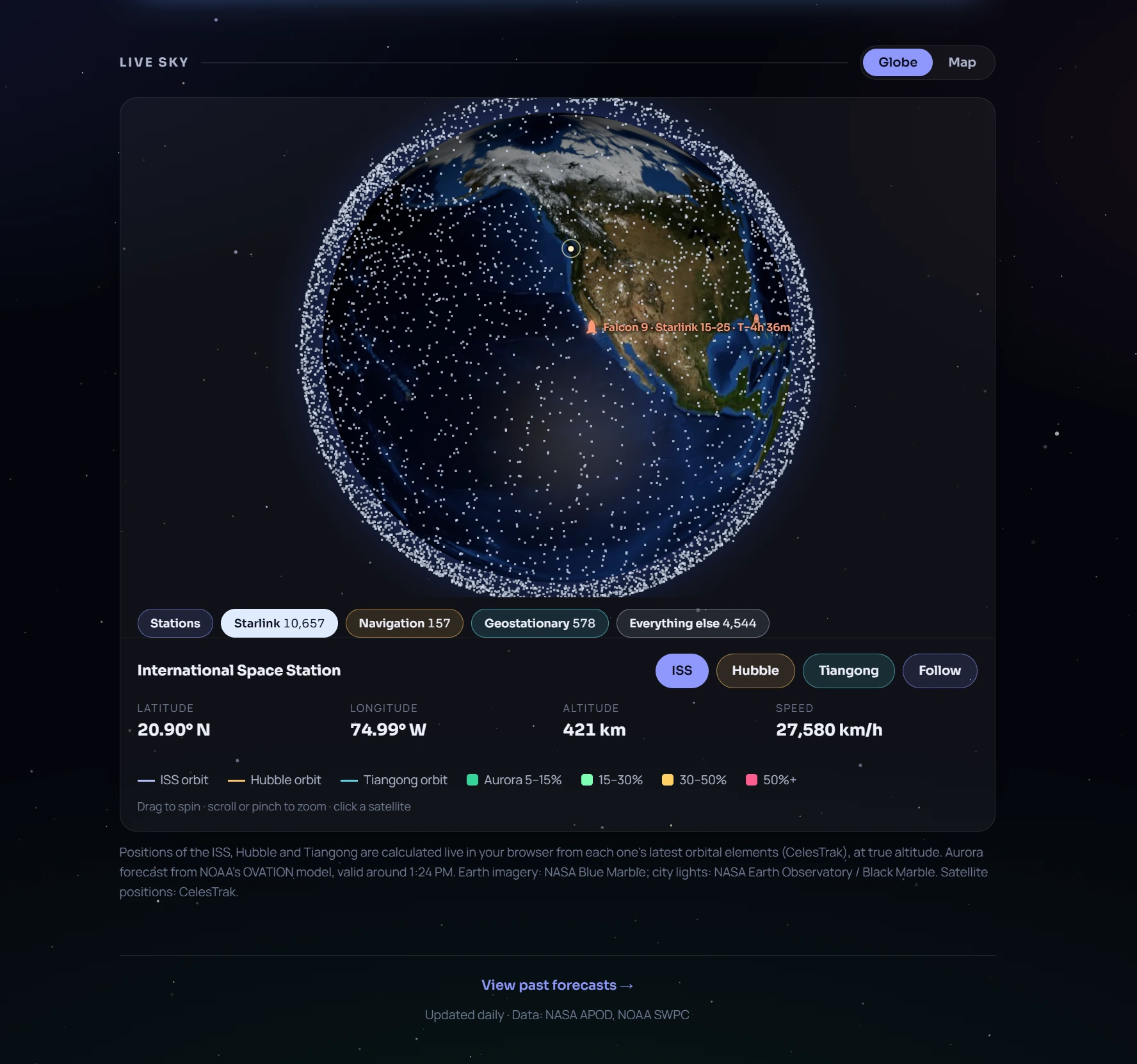
Live Sky · screenshot supplied by Jeff Taylor. Counts, positions, and countdowns reflect the captured session.
01 / Purpose and contribution
From a simple class project to a public application.
The application answers practical questions: what is in orbit, what can I see from my location, and what is happening in space today?
I built the original class project and have owned its development and maintenance since March. I designed the application, implemented its features, deployed it, and maintain it. Over time, I removed the sign-up wall, preserved historical images, moved hosting to my company’s Azure account, and added the live globe and location-based sky information.
I use AI-assisted workflows for planning, implementation, and debugging. I make the technical decisions and review changes before they go into the application. AI contributions are documented in the repository’s commit history.
Timer-triggered Azure Functions collect external data into Azure Blob Storage. The ASP.NET Core MVC application reads those snapshots and serves pages and JSON endpoints. In the browser, a Web Worker computes satellite positions for the interactive globe.
Source dataNASA, NOAA, CelesTrak, The Space Devs
Azure FunctionsScheduled collection and parsing
Blob StorageSnapshots, digests, and archived images
ASP.NET Core MVCPages and feature APIs
BrowserWorker propagation and globe rendering
Separating collection from page requests reduces dependence on upstream response times. The tradeoff is freshness: each feature depends on its collection interval and the latest usable snapshot, so update times and health checks matter.
03 / Engineering decisions
Reliability and responsiveness.
Publish through source failures
The daily collector tries NASA’s API, then RSS, then a previous usable picture. Space weather can still publish when the picture is unavailable. Fresh images are copied into storage to reduce broken historical links.
A carried-over picture keeps its original date; availability should not imply freshness.
The satellite worker builds orbit records only for enabled groups and returns positions as transferable typed arrays. This avoids doing bulk satellite propagation on the thread responsible for page interaction.
Satellite positions depend on the available orbital elements and propagation models.
The repository includes a reference-vector test for SGP.NET using Vanguard 1 at three times after the orbital epoch, with a 50-metre position tolerance.
That is a bounded regression check. It does not establish the accuracy of every satellite or every visible-pass prediction.
The freshness health check evaluates the latest digest’s date and reports healthy, degraded, or unhealthy status. This helps distinguish a running web process from a working data pipeline.
The repository also includes storage health checks and tests for freshness boundaries and malformed data.
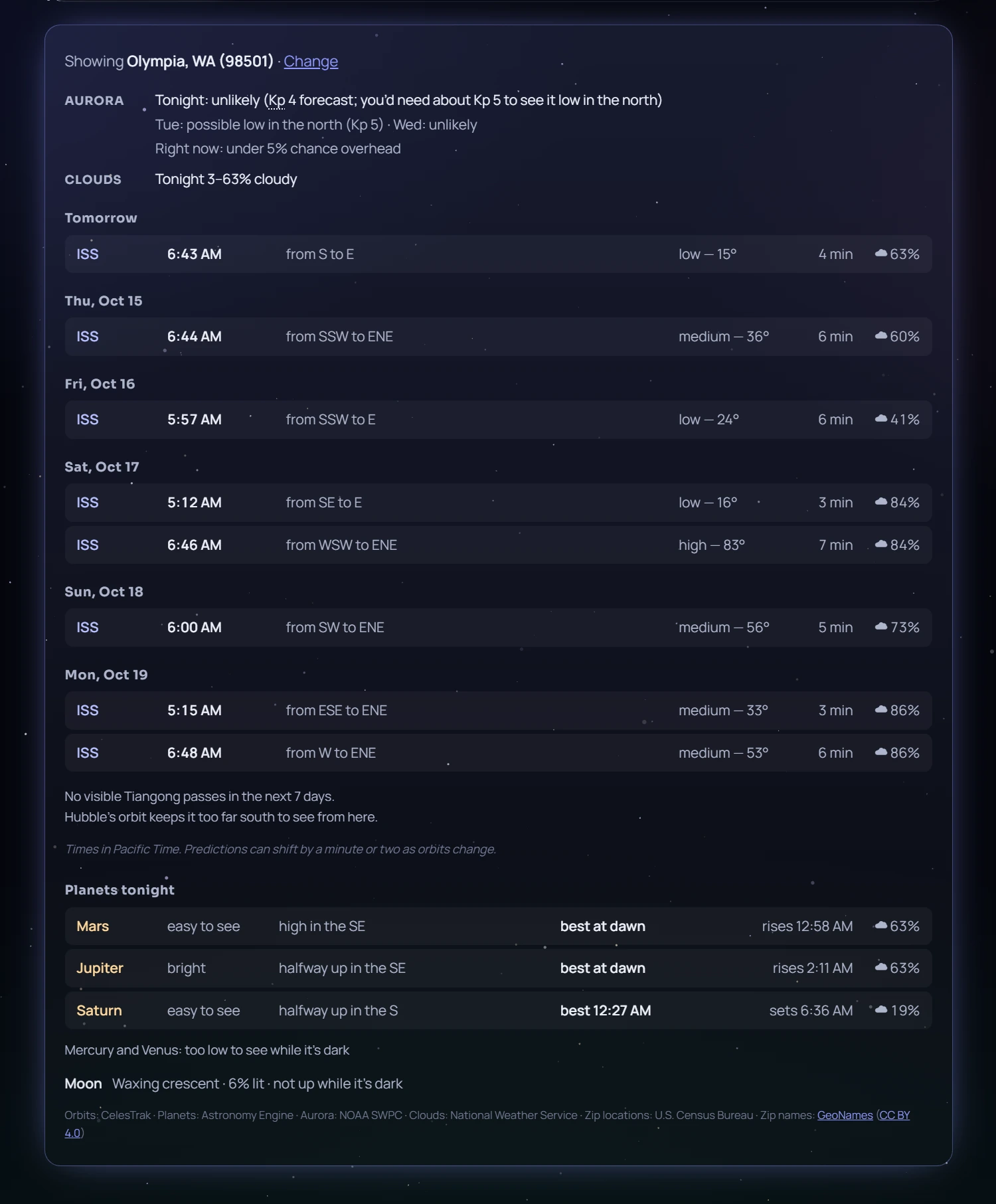
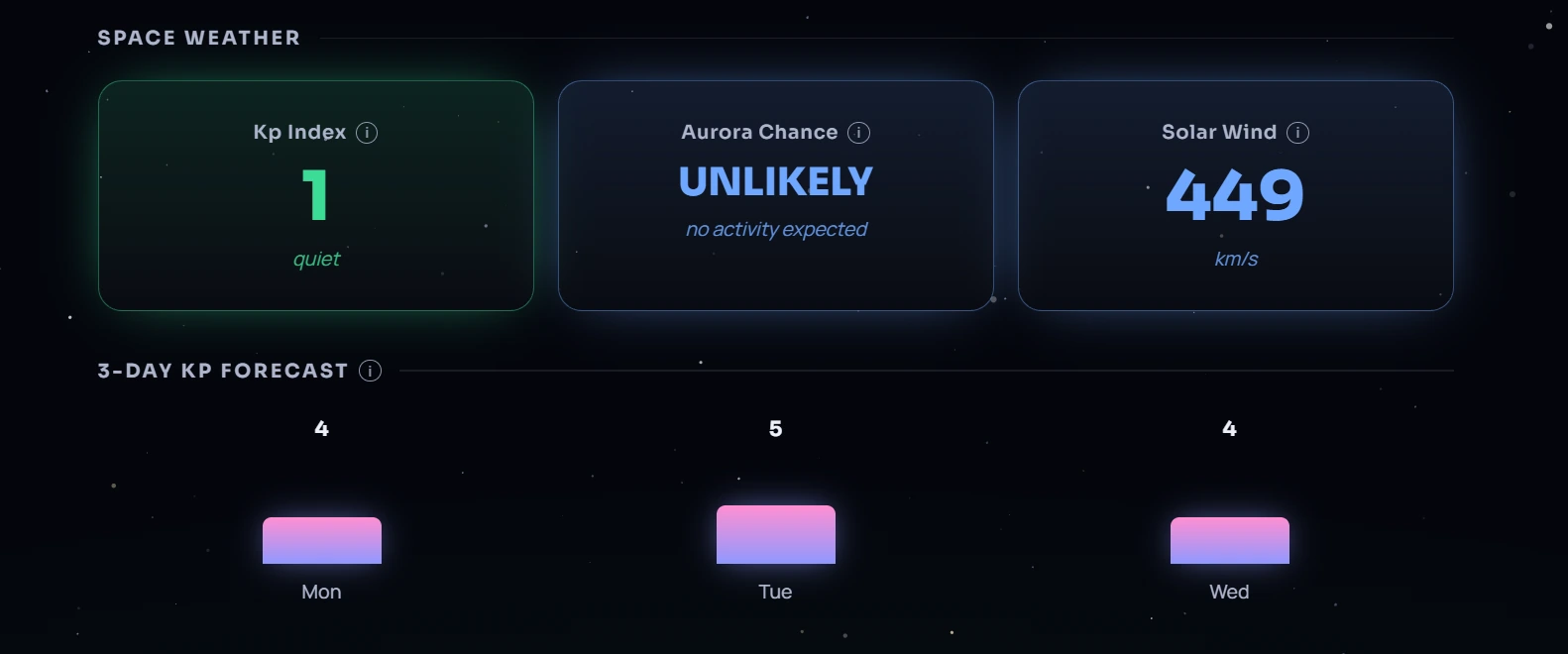
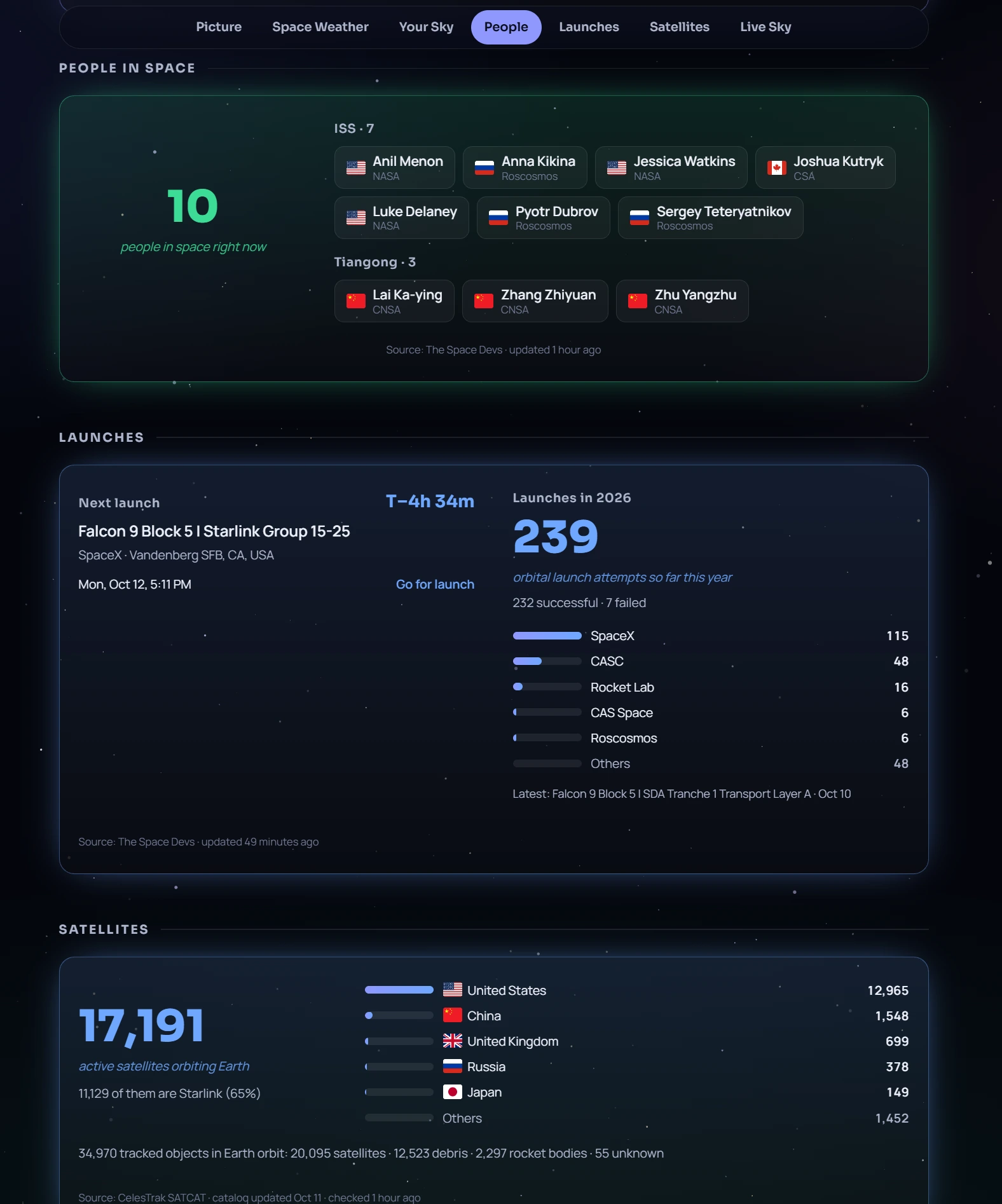
Open a screenshot to inspect each feature. Dates, forecasts, counts, and launch times reflect the captured session. Earth imagery is from NASA Blue Marble and Black Marble; forecast and orbital context come from NOAA and CelesTrak.
Your Sky — visible passes and weatherYour Sky · location-based pass information with weather context.Space Weather — current readings and forecastsSpace Weather · source readings presented with explanations.People, launches, and satellite countsPeople, launches, and satellites · independently refreshed data views.Earth snapshot — server-rendered imageEarth snapshot · server-rendered image for widgets and link previews.
05 / Evidence and limits
What this project demonstrates.
The live application and repository provide inspectable evidence of data integration, scheduled processing, cloud deployment, browser workers, and tests for selected failure modes and calculations.
The reference-vector check covers one satellite at three points in time. It provides a regression check alongside the parser and freshness tests.
Further work can measure page latency, globe performance across devices, and behavior during simulated upstream outages.